
What Does a Nonprofit Controller Do — And Does Your Organization Need One?
A nonprofit controller ensures your financial data is accurate, your books are audit-ready, and your internal controls are working. Learn what the role covers and whether your organization needs one.
Last year, the executive director of the East Oakland Boxing Association, a Bay Area-based nonprofit serving low-income children, was sentenced to 27 months in federal prison. The case involves more than more than $500,000 in embezzled funds that the defendant transferred from the organization’s bank accounts into his own — money intended for tutoring, boxing programs, and internships for local youth.
In the nonprofit world, such cases aren’t all that uncommon: Nonprofits account for 10% of the occupational fraud cases analyzed in the Association of Certified Fraud Examiners 2026 report. Understandably, these crimes are often the first thing that comes to mind when nonprofit leaders hear the word “controller.” But fraud and theft are a far lesser threat to most organizations than the everyday risks of bad accounting.
We’ve been working with nonprofits for a long time, and the total dollars lost to simple mistakes — sloppy bookkeeping, miscoded expenses, and restricted funds spent in the wrong place — would make your eyes water. And yet, controllership remains one of the most overlooked roles in the sector. Here, we'll break down the role of the nonprofit controller: what they do, how controllership fits into your financial structure, and how to know when it's time to get serious about it.
Understanding controllership for nonprofits
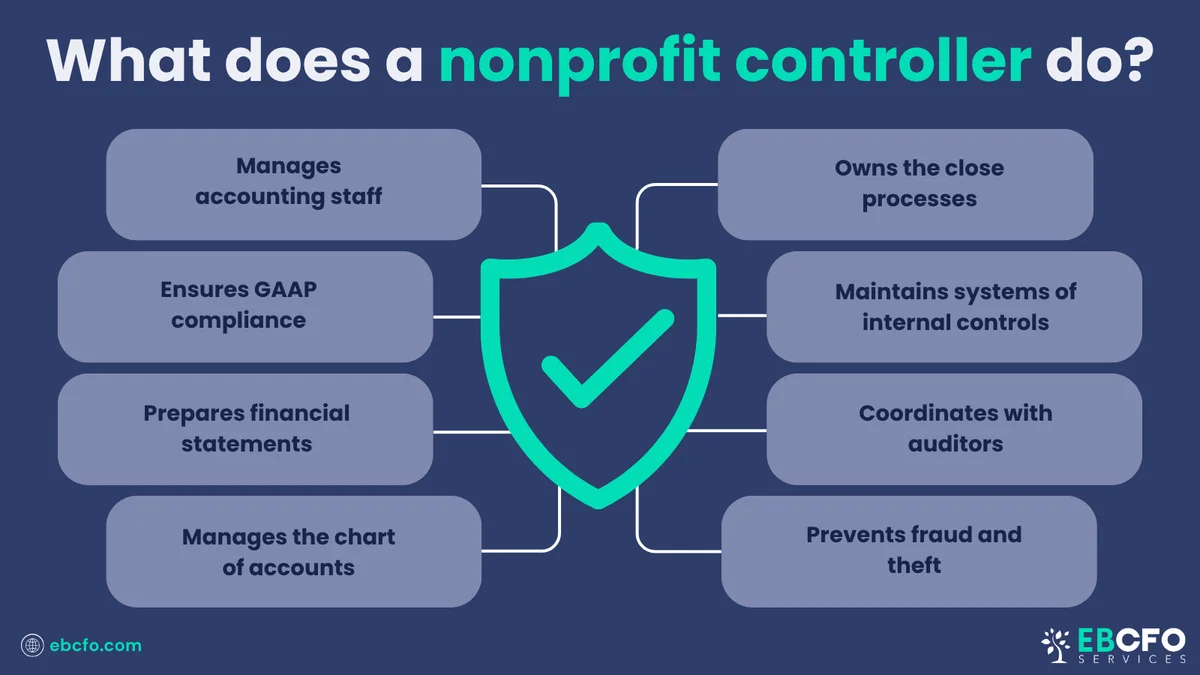
A controller is the person responsible for the integrity of your accounting function. They’re the ones who truly own your finances, making sure the data — and everything that flows from it — is accurate, timely, and audit-ready. This includes:
Managing your accounting staff
Overseeing month- and year-end close process
Ensuring GAAP-compliance
Creating and maintaining accounting systems and processes (i.e., internal controls)
Preparing and reviewing financial statements
Coordinating with external auditors
Managing the chart of accounts and general ledger
Without this function operating well, everything downstream is built on shaky ground. Board reporting, grant management, strategic planning — that all relies on sound data. If you don’t have someone to oversee your accounting department, your decision-making apparatus can’t function to its full capacity, and accounting mistakes won’t surface until they cause a bigger problem.
The other major responsibility of a controller is to prevent the misappropriation of funds. As mentioned above, fraud and theft are more common in nonprofits than most leaders realize, and the absence of proper controls is often what makes it possible.
How a controller fits into your financial ops
Your controller is the layer between your accountant and your leadership team. It’s a critical function that must necessarily exist independently from each, and collapsing it into either role creates real risk.
Your accountant, of course, can’t realistically review their own work — the whole value of a controller is that it’s a different set of eyes. If the person recording transactions is also the person verifying them, errors go uncaught and fraud becomes much easier to conceal.
For the same reason, your CFO and your controller functions can't fall on the same person: separation of duties. It’s one of the fundamental tenets of nonprofit financial governance, and it’s a standard line of inquiry for auditors.
Beyond compliance, there's a practical reality: your CFO is focused on the big-picture, forward-looking questions on the strategy side, which leaves little room for transaction-level oversight. What’s more, a CFO has a stake in how the financials look — they're presenting the numbers to the board and making strategic cases with them. Doubling as controller creates a conflict of interest.
When do you need a controller?
There's no universal threshold that signals it’s time to invest in a controller; it’s really a question of how complex your finances are.
It obviously wouldn’t make sense for a fledgling nonprofit with a handful of employees and a part-time accountant to hire a controller (though they should still set up a basic system of internal controls suited to their size).
But what we often see is that nonprofit organizations grow pretty quickly, and they’re so busy scaling their operations and expanding their programs that their accounting function lags behind. And while the necessity of an accountant and a CFO is clear, controllership often gets overlooked until the organization is already feeling the consequences.
Here are some signs it’s time to hire a controller:
Your monthly close process takes weeks instead of days, or doesn't happen consistently at all
You're preparing for an audit and your financials aren't ready
A recent audit revealed weaknesses in your internal controls
Your CFO or Executive Director is making financial decisions without reliable, up-to-date data
You've grown to multiple programs, funds, or revenue streams
Grant reporting and compliance requirements are slipping through the cracks
Your accountant is maxed out with no one qualified to review their work
The good news is, you don't have to hire a full-time controller to solve these problems. Outsourced controllership gives mid-sized nonprofits access to the expertise they need without the overhead of a full-time employee.
Tips for bringing controller support into your nonprofit
If you suspect your organization might need controller support, here are a few things to keep in mind as you think through next steps.
1. Don’t wait until you’re in crisis
Most nonprofits bring in controller support after learning the lesson the hard way: A bad audit, a chart of accounts in disarray, or a tense board meeting where the financials get called into question. Our best advice is this: don’t wait until things go sideways. As soon as you break out of that initial growth phase and are bringing in serious capital, you need someone to keep your accounting function tight.
2. Make sure your controller understands nonprofit accounting specifically
Nonprofit controllership is a specialty area. When you're evaluating candidates, ask specifically about their experience in the nonprofit sector; you’ll want someone who knows their way around fund accounting, grant reporting, and nonprofit audits.
3. Consider outsourced controllership
Outsourced controllership has become an increasingly common model for nonprofits that need senior financial oversight but aren’t quite big enough to warrant a full-time hire. A fractional arrangement is flexible, scalable, and often faster to put in place than a traditional recruitment process.
Get the financial oversight your nonprofit actually needs.
Controllership is a critical pillar of your financial infrastructure. It's not the most visible part of running a nonprofit, but it's what everything else depends on: accurate reporting, clean audits, compliant grant tracking, and financial statements your board can trust.
At EBCFO Services, we've spent years helping nonprofits build the financial infrastructure they need to operate with confidence, and controller support is one of the first things we help them get right. If you’re ready to build that, let’s talk.