
The Complete Guide to Nonprofit Financial Reporting
With the right approach, you can turn your accounting operation into the engine of your nonprofit’s decision-making apparatus.
For nonprofit finance teams, producing clear, comprehensive, and genuinely useful reports can feel like a monumental undertaking.
You’re dealing with a ton of data, and you’ve got to find a way to make the numbers make sense to folks who may or may not be “numbers people”. What’s more, your organization’s key stakeholders — executive leadership, board of directors, internal teams, and funders — each need different levels of detail and context in order to make good decisions.
All of this means that accounting teams often struggle to create reports that are both technically correct and user-friendly, which can quickly become a problem for the organization as a whole. As the old adage goes, you can’t manage what you can’t measure.
But with the right approach, you can turn your accounting operation into the engine of your nonprofit’s decision-making apparatus. Here, we’ll cover everything you need to know about nonprofit financial reporting, from the key reports you need to have at-the-ready to the audience-specific ones for each of your stakeholders. With this guide, you’ll be ready to put your financial data to work for your mission.
Why nonprofit financial reporting often falls short
Nonprofit accounting is a multi-headed beast. While financial reports for for-profit businesses tend to center on profitability and performance metrics, accountants in the nonprofit space have a number of other considerations to juggle: Which dollars are truly available to spend? Which are locked to specific programs? Where are you at risk?
Ideally, your reports answer these types of questions so stakeholders can plan their next moves. In reality, many nonprofits end up with reports that are technically accurate but strategically unhelpful. Here’s what that often looks like:
Too much detail: While your accounting team might need a high level of granularity to understand what’s going on, your board and leadership probably just need a high-level overview of the organization’s financial standing.
Reactive instead of proactive: While your reports must necessarily be built around historical data, those who need that data will also need forward-looking analysis so they can think ahead.
Built for accountants, not leaders: Accountants tend to default to a dollars-and-cents perspective, but leaders often need that translated into qualitative data too.
No consistent cadence: Too often, review financial reports are reviewed sporadically, such as just before a board meeting or during a crisis. If you’re not in the habit of checking in on your financials regularly, small issues snowball and opportunities get missed.
Spreadsheet sprawl: Spreadsheets are excellent tools, but they’re not a good place for financial recordkeeping — things get messy fast, and they tend to beget fragmented reports that don’t translate easily into clear insights
What effective reporting looks like
Mastering the art of financial reporting means thinking first and foremost about your audience. Which metrics do they need, exactly? What do these numbers mean for them? How easy can they understand the reports and glean the necessary information? How often are they reviewing the reports?
In other words, it comes down to user-friendliness. Just as you need well-designed technology to help you navigate your work and personal life, or well-designed infrastructure to navigate the wider world, your organization needs well-designed financial reports to help your stakeholders navigate its future.
So, what does that look like in practice?
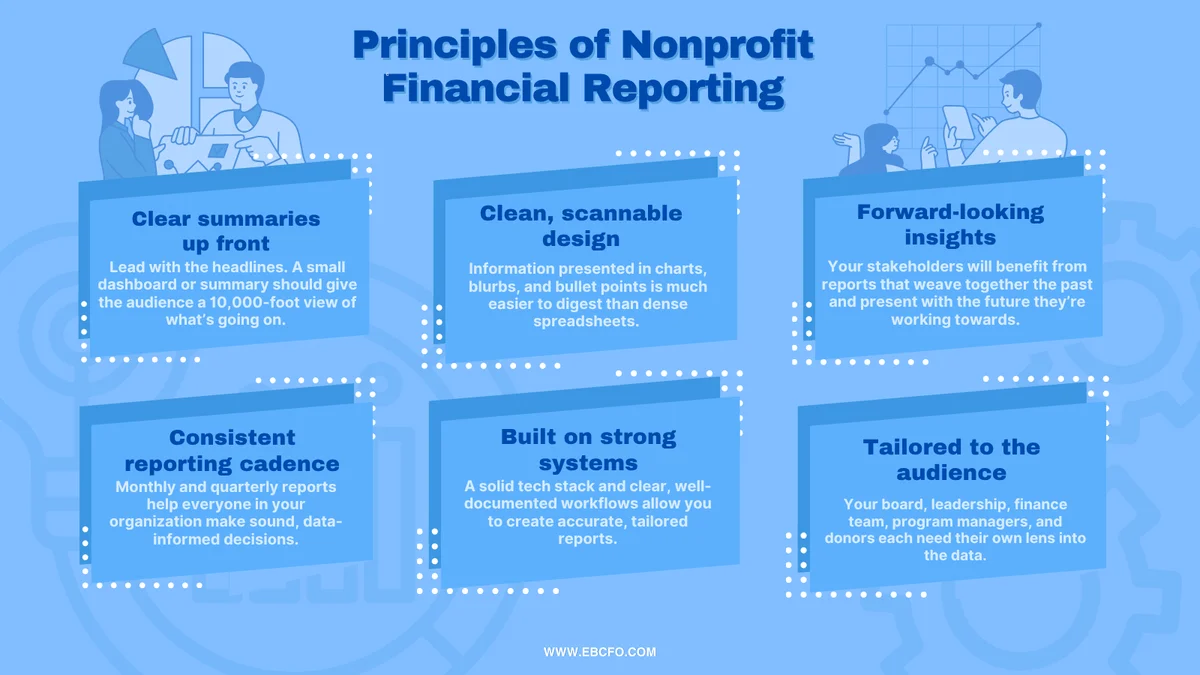
Clear summaries up front: Lead with the headlines. A small dashboard or executive summary should give your audience a 10,000-foot view of what’s going on.
The right level of detail for the audience: Your board doesn’t need transaction-level data, and program managers don’t need organization-wide financials. Tailor each report to your audience.
Clean, scannable design: Information presented in charts, blurbs, and bullet points is much easier to digest than dense spreadsheets. Well-built reports won’t leave your audience feeling confused or overwhelmed.
Forward-looking insights: While you might base them on historical data, your stakeholders will benefit from reports that weave together the past, present, and future.
Consistent cadence: Monthly and quarterly reports keep everyone in your organization on the same page. A strong reporting infrastructure makes that possible.
Reliable systems behind the scenes: A solid tech-stack and clear, well-documented workflows allow you to generate high-quality, tailored reports at regular intervals for each of your stakeholders.
With these as your guiding principles, your accounting operation can serve as your navigation system, allowing leadership to tether strategy to your organization’s financial realities.
Reporting for different audiences: boards, leaders, and teams
To effectively tailor each report to a specific audience, you’ll want to think carefully about the needs of those audiences. Here, we’ll break down what the needs of each audience could be. Of course, you’ll leverage your own knowledge of your organization (and your colleagues) to put together a truly tailor-made report.
Board reporting
Your board members are focused on governance and oversight rather than day-to-day operations, so they’ll likely prefer a high-level view of your organization’s financial health. Your board reports should emphasize trends, highlight key metrics, and present big-picture indicators like cash runway, reserves, and budget performances. Generally speaking, it’s wise to avoid highly granular data or technical accounting language here.
Executive leadership reporting
Executive-level reports will need to be both in-depth and future-oriented: think cash flow projections, scenario modeling, and program-level performance data. Rather than including a ton of historical data, consider which metrics your leadership team needs to effectively evaluate tradeoffs and plan ahead.
Finance team reporting
For your finance team, reporting serves a different purpose entirely; here, the focus is on accuracy and compliance. That means detailed reconciliations, transaction-level data, fund tracking, and close processes that satisfy the needs of your controller. These reports must necessarily be more granular and technical, as they’ll form the operational backbone that makes every other report available.
Program managers and department leads
The folks running your programs and/or departments will need reporting that reflects their work. Keep it focused on their budget, performance, and goals alongside plain-English summaries. Your goal here is to empower them to manage their resources wisely and make informed day-to-day decisions.
Funders and external stakeholders
Lastly, your donors and external stakeholders will want reports that support transparency and compliance. They’ll need to see how funds are used and how those expenditures align with outcomes or impact. It might be wise to include some info about your operational costs so they feel confident that their contributions are being managed responsibly.
The core financial reports every nonprofit should have
Now that you understand the design principles that underpin great financial reporting, let’s delve into the nuts and bolts so you understand what to include. As discussed above, however, there is no one-size-fits-all financial report — you’ll want different “versions” for each audience. So as you consider how to build your report, be mindful of whether a particular audience might need a different dataset or level of detail.
Report | Primary stakeholders | Level of detail | Visual/format tips | Decision-making value |
|---|---|---|---|---|
Statement of financial position (balance sheet) | Board, executive leadership, finance team | Medium–high | Summarized categories for boards; full detail for finance | Liquidity, reserves, financial stability, debt obligations |
Statement of activities (income statement) | Board, executives, program leads | Medium | Trends, % of budget, and program splits | Sustainability, spending patterns, program performance |
Cash flow reporting & runway analysis | Executive leadership, finance, board (summary) | Medium–high | Line charts, 3–6 month forecasts, runway visuals | Hiring, expansion, risk planning, timing decisions |
Budget vs. actuals | Executives, department heads, finance | High for managers, summary for board | Variance columns, color-coded highlights | Course corrections, accountability, spending control |
Program or fund-level reporting | Program managers, development, grants team | High | Simple tables by program/grant, burn-rate trackers | Grant compliance, cost recovery, resource allocation |
Board dashboard or summary page | Board of directors | Low (intentionally) | 1–2 pages max, charts + KPIs + commentary | Oversight, governance, big-picture direction |
Building systems that make reporting easy and reliable
If producing tailored reports for all of your various stakeholders sounds like a tall order, you’ll be reassured to know that you don’t have to do it all manually. Once you get your internal systems and processes nailed down, your reporting function will be more or less automatic. Here, we’ll explore how to build those systems for your organization.
Clean chart of accounts
You’ll of course need to start with a clean, well-architected dataset: your chart of accounts (CoA). If your current CoA hasn’t been well-maintained, you’ll need to think about how to simplify and restructure it to support reporting; otherwise, things like account sprawl and categorization inconsistencies will get in the way. If this is out of your accounting team’s wheelhouse, it might be worth connecting with a nonprofit accounting consultant to give you a hand.
Consistent coding practices
The way any given transaction is coded within your CoA will determine how it’s reflected in your financial reports. A common issue we see with nonprofits is the absence of clear, documented coding policies. Often, this type of institutional knowledge lives in the head of a particular team member rather than an SOP document. For effective reporting, you’ll need to keep your entire team on the same page with regard to coding, even with turnover and organizational change. This necessitates keeping those practices enshrined in your documentation.
Monthly close process
You’ll also need a standard checklist for your monthly close process; ditto for quarterly and yearly closes. In addition to the typical reconciliations and reviews required by your controller, you should think about which metrics you’ll need for your reports and work back from there. Designing your close process around reporting outcomes is a good way to make sure you can always get those reports out to the people that need them on a regular basis.
Cloud-based, collaborative tools
In this day and age, there’s simply no good reason for your accounting operation to live offline. Keeping your data in the cloud and your workflows in well-designed, collaborative platforms means you’ll always have what you need to produce the reports your organization depends on. If you’re still working within spreadsheets and legacy systems, it might be time to shop around for a tech stack that supports efficiency, transparency, and automation.
Documentation and internal controls
We’ve already touched on the importance of maintaining your accounting department’s controls and documentation, but it’s worth reiterating here. These procedures are fundamental to your reporting infrastructure because they protect the integrity of your data. Keep your documentation thorough and up-to-date, and be sure to include information specific to your reporting procedures. The idea here is that no single individual becomes a single point of failure; no matter who’s managing your accounts, the systems stay the same.
How strong reporting supports better strategy
In order for your leadership team to do the kind of behind-the-scenes planning your mission deserves, you’ll need a robust reporting infrastructure. Your financial data tells you what’s happening, what’s possible, and what’s sustainable, making those reports an indispensable tool for decision-making.
Is it worth it to hire an extra set of hands? How feasible is it to expand that program? Where do you need to focus your fundraising efforts? These are just a few of the questions that strong financial reporting can help you answer.
To the uninitiated, reporting might feel like a box to check. But when we set our clients up with a great system for producing clear, useful reports, they’re often surprised by just how transformative it can actually be. Suddenly, the path forward becomes clear and intentional.
When to bring in outside expertise
If you don’t yet have the kind of reporting functionality that your teams need to make data-informed decisions, it’s worth examining the feasibility of setting that up yourself. If you already have a clean chart of accounts and the right tech stack, it may just be a case of poking around in your accounting software’s reporting features, building the ones you need, and automating them for regular delivery to your team and board.
But if you’re working with legacy systems, messy data, or limited internal capacity, you’ll probably benefit from bringing outside help. An experienced, systems-minded accounting expert can help you restructure your financial architecture and design systems that produce clear, decision-ready reports for each of your stakeholders.
At EBCFO, we’ve helped dozens of nonprofits and emerging businesses do just that. If you’re looking to overhaul your reporting capabilities, let’s talk.
Takeaway
When built thoughtfully, financial reporting gives your board and leaders the visibility they need to hire wisely, grow intentionally, and steward resources responsibly. Invest in the systems that produce clear, decision-ready reports, and you transform finance from a historical record into a forward-looking guide. If you don’t yet have decision-ready reporting capabilities built into your accounting function, don’t hesitate to reach out to a nonprofit finance partner like EBCFO.