
Measuring Success for Nonprofits: Outputs, Outcomes, and your Lodestar Metric
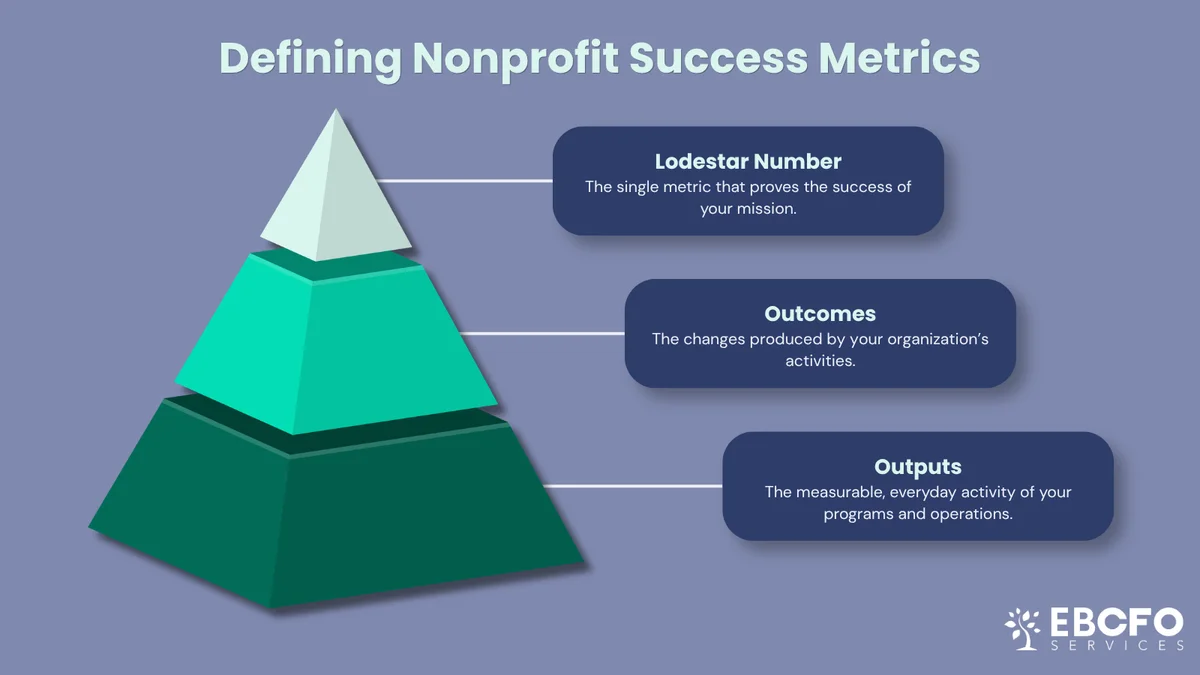
If you could track only one number to prove your nonprofit is succeeding, what would it be? Here's how to think through operational outputs, organizational outcomes, and finding your lodestar metric.
Across the nonprofits we work with, we see the same struggle play out: leadership knows their mission, but over time, they start to lose sight of it as their programs begin to drift towards day-to-day deliverables. Their accounting dashboards show all the obvious metrics, like cash flow and fund balances, and — as long as everything is in the green — leadership may not ask the most obvious question: Is any of this working?
But if leadership isn’t zooming out to scrutinize the bigger picture, funders eventually will. So leaders need to be asking the hard questions. And ideally, they’re able to give answers that show real progress, along with a number that proves it.
That's where the idea of a lodestar metric comes in: the single number that best reflects whether your organization is actually achieving its mission. Here, we'll explain the difference between outputs and outcomes, walk through how to find your organization's lodestar number, and show you how to orient your finance function towards it.
The Problem of Success Metrics
Nonprofits depend on funding from people who share their vision. And in order to keep funds flowing, they need to prove they’re making progress towards clear objectives that will make that vision a reality. But unlike in the business world, with a single bottom line and investors willing to play the long game, nonprofits need to establish their own success metrics and carry out their objectives with far fewer resources, and often on a shorter timeline.
Nonprofits commonly struggle to define the numbers that reflect their mission; oftentimes, this is because the objectives are inherently qualitative rather than quantitative. Many worthwhile goals can’t be expressed in a single data point: families made stable, an ecosystem preserved for future generations, stronger community bonds.
Nonetheless, nonprofits need to show their work in order to keep the funding flowing towards their vision. And the work of any given program often can be expressed numerically: meals served, trees planted, events attended. That data can offer critical insights, but it doesn’t necessarily prove that the mission is being fulfilled; it just shows that something has been done. To measure success, you need to look at outcomes.
Outputs vs. Outcomes: What’s the Difference?
Outputs and outcomes answer two different questions: what did you do, and did it work? Both need to be measured, but it’s outcomes that prove your success. |
Outputs are your actions
An output is the immediate, countable result of a nonprofit's work. Your organization’s everyday activities produce these outputs. For a rescue mission, that would be things like intake sessions, meals served, or classes attended; for a public garden, it could be school group attendance or acreage under cultivation.
Outputs are the easiest things to point to when justifying resource usage: each activity generates its own trail of numbers, and they can be tracked using your existing systems. The data is often available on a daily basis and can be routed directly to your accounting software. Your leadership team, board, and funders will of course want to see this data, so it’s crucial that you’re including it in your reports.
But it’s not the whole story because outputs don’t always translate to long-term results. If a homeless services organization is investing heavily in job training but 70% of its clients are still unhoused a year later, how effective is that service? If a public garden spends millions on a new installation but membership stays stagnant, was it worth it?
Chasing outputs means missing the forest for the trees: your organization may be busy, but whether that work translates to impact is an entirely separate question.
Outcomes are your impact
Outcomes represent the underlying purpose driving your organization’s programs. These are the long-term, high-level effects that underpin your mission statement — the sum of your outputs.
Outcomes can be difficult to measure. For one, what counts as success isn't always obvious, particularly when your mission is defined in qualitative terms. Data collection can also be an issue: outcomes may take months or years to materialize, and tracking them over that timeframe requires resources that many organizations don't have.
A rescue mission might measure success by how many clients achieve sobriety, retain employment, or move into permanent housing. But how long does someone need to stay stable before it counts as "success"? What happens if a client relapses six months in: does that nullify the program’s impact? And how do you track those outcomes?
These are hard questions, and there's rarely a clean answer. But it’s worth investing in the systems and processes needed to track outcomes, because they're what stands between your outputs and your lodestar number: the single metric that proves whether your organization is effective.
What is a Lodestar Number?
Your lodestar number distills your mission into a single metric. It represents the totality of your outcomes and reflects what your organization is working toward.
In our rescue mission example, that might be the number of clients who remain stably housed one year after leaving the program. This number works as a lodestar because it captures three things at once:
It reflects outcomes, not outputs. A bed filled for the night is progress, but long-term stability is the point.
It accounts for time. Measuring housing status a full year out means the number can't be inflated by short-term wins.
It's honest about failure. A number like this forces a real answer as to whether the org’s programs and services are helping to move the needle on outcomes.
Finding Your Lodestar Number
Dialing down on a lodestar number involves working backward from your mission until you land on the single metric that proves it's being fulfilled. Here's how to find yours.
1. Start with why you exist
First, revisit your mission statement. What is your organization’s reason for being? Who do you serve, and how? You’re working toward some ideal — what is it?
2. Find the metric that best reflects your mission
With a good sense of your mission, you can work backwards to find a number that could prove your effectiveness. This is tricky when your mission statement is abstract, so you’ll want to ask yourself what concrete, observable thing would have to be true if your mission were succeeding.
Take a public garden whose mission is to "inspire an appreciation for the natural world." Appreciation isn't something you can count directly, but someone truly inspired keeps coming back. Membership renewal, then, could be the lodestar metric, because it’s the observable, trackable version of an otherwise abstract goal.
3. Orient your organization around the number
Once you’ve identified your number, review your strategy and operational priorities with a critical eye. The idea is to draw a throughline between your day-to-day activities and the big-picture results that demonstrate your effectiveness.
If some program isn’t measurably advancing your mission, it may be worth reconsidering; if there’s something that could have a bigger impact, it might be worth making that investment.
Many organizations lose the thread at this step. Even with their mission top-of-mind, operations are built around outputs with questionable long-term value. Grant opportunities may be pursued because they’re fundable; new programs get added because a board member is excited about it; longstanding programs stick around because no one wants to be the one to cut them.
This kind of drift is easy to fall into, which is why committing to your number involves active, ongoing decision-making at every level of the organization.
Committing to Your Number
Defining a lodestar metric often means recognizing when you need to narrow your focus and allocate resources to what truly drives positive outcomes. This starts with auditing your current strategy: look at every program, service, and initiative currently on your books and ask whether it’s pulling resources towards your lodestar number or away from it.
This is tricky, because nearly everything a nonprofit does responds to a real need. But a real need alone doesn’t necessarily justify the resources it takes to meet that need.
For example, a homeless services organization might feel compelled to provide addiction counseling, legal aid, and financial literacy classes on top of its core work. Though such services can be genuinely helpful to those in need, each new program pulls resources from the employment and housing programs that more directly serve the organization’s mission.
When saying “no” isn’t the right call
Though a focused strategy is generally the more effective approach, saying no to tangential programs isn’t always the right move. If your organization is the only one available to meet the needs of your community, you could be the last line of defense. And in that case, the demand may be a signal that your organization has room to grow.
Your understanding of your community also means you’re also likely the one best-equipped to spot opportunities for meeting their needs at scale. That could mean creating a spinoff initiative with its own dedicated resources, investing time in public policy advocacy, or partnering with businesses to share the load.
In short, you want to think of ways to amplify your impact in the long-term so that you’re not forced to shoulder the burden alone forever.
From Ledger to Lodestar: Aligning Your Accounting with Your Mission
Because it’s the metric guiding your strategy, your lodestar number should serve as the anchor of your organization’s chart of accounts.
Healthy nonprofits structure their accounting so every dollar can be traced back to the outcome it's meant to serve, and in doing so, they make it far easier to prove their impact to their board and funders. Here are some tips for aligning your accounting function with your mission.
Define and measure the goals that underpin your mission
With your lodestar metric in mind, you should be able to define a number of sub-goals that serve your broader organizational goals. Those sub-goals are what your outputs should actually be building toward, so make sure each has a clear, trackable metric attached to it.
Build your data collection infrastructure
Outputs are usually straightforward to log — your CRM, POS, and volunteer management systems are likely already collecting that kind of data. Outcomes are trickier, and you may need to build out your data collection capabilities to measure lasting impact. That could mean investing in case management software or client survey tools, or configuring your existing systems to track the metrics you need.
Implement strong reporting processes
If you’ve got the right systems in place, you should be able to produce reports that reflect progress at every level of your organization, tailor them to each stakeholder type, and deliver them at regular intervals. Your board gets the organization-level insights it needs to guide strategy, while management and program directors get the data they need to keep operations running smoothly and on-target.
Takeaway
Your organization’s programs and services make up the visible work, but it’s your mission that imbues that work with purpose. Connecting your purpose to a clear metric — your lodestar number — cuts through the noise of everyday activity and tells you whether you’re moving the needle on that mission.
With a clear number to guide you, your strategy falls into place: It becomes easier to make decisions about which programs deserve more investment, which no longer serve the mission, and how to report meaningful progress to your funders. That’s the value of a lodestar metric: it keeps all of your activities oriented towards the vision shared by your team, board, and funders.
At EBCFO Services, we help nonprofits build data-driven financial strategies, and the systems to support them. If you're struggling to connect your numbers to your mission, let's talk.