
Nonprofit Accounting Basics: A Plain-English Guide for Nonprofit Leaders
Learn the fundamentals of nonprofit accounting: what you need to know, what you need to have in place, and what to watch out for as your organization grows.
If you’re leading a growing nonprofit, you already know how quickly your accounting operation gets complicated.
One day, you’re managing just fine with some out-of-the-box accounting software, and the next you’re spending untold hours navigating a tangle of grant restrictions, donor reporting requirements, and compliance deadlines that your software wasn’t built to handle. Nonprofit accounting is complicated, to say the least, and for nonprofit leaders without a finance background, even knowing where to start can feel overwhelming.
Here, we'll break down the fundamentals of nonprofit accounting in plain English: what you need to know, what you need to have in place, and what to watch out for as your organization grows. With this guide, you’ll be well-positioned to build a solid accounting function for your organization so you can make sound, data-informed decisions.
Nonprofit accounting: A brief overview
Nonprofits have specific needs when it comes to accounting. In addition to the typical functions required for any organization, you’ve got to think about staying on the right side of donors, grantmakers, and regulators.
First and foremost, that means every dollar you receive needs to be tracked in terms of its intended purpose: restricted funds are earmarked for specific programs or initiatives, and unrestricted funds cover operating costs and anything else your organization might need. This distinction is at the heart of fund accounting, the system most nonprofits use to organize their finances. And it’s not just good practice: GAAP standards require nonprofits to track and report funds this way.
IRS regulations are another major consideration. Your 501(c)(3) status means you need to file a Form 990 every year, which breaks down revenue, expenses, executive compensation, and program accomplishments. And because this data is public, it’s extra important to make sure your financials reflect well on the organization.
You’ll also want to put your accounting data to good use. Your accounting operation should provide you with the data insights you need to make great leadership decisions. If your organization’s stakeholders aren’t getting regular reports that connect your finances to their goals, they’re flying blind.
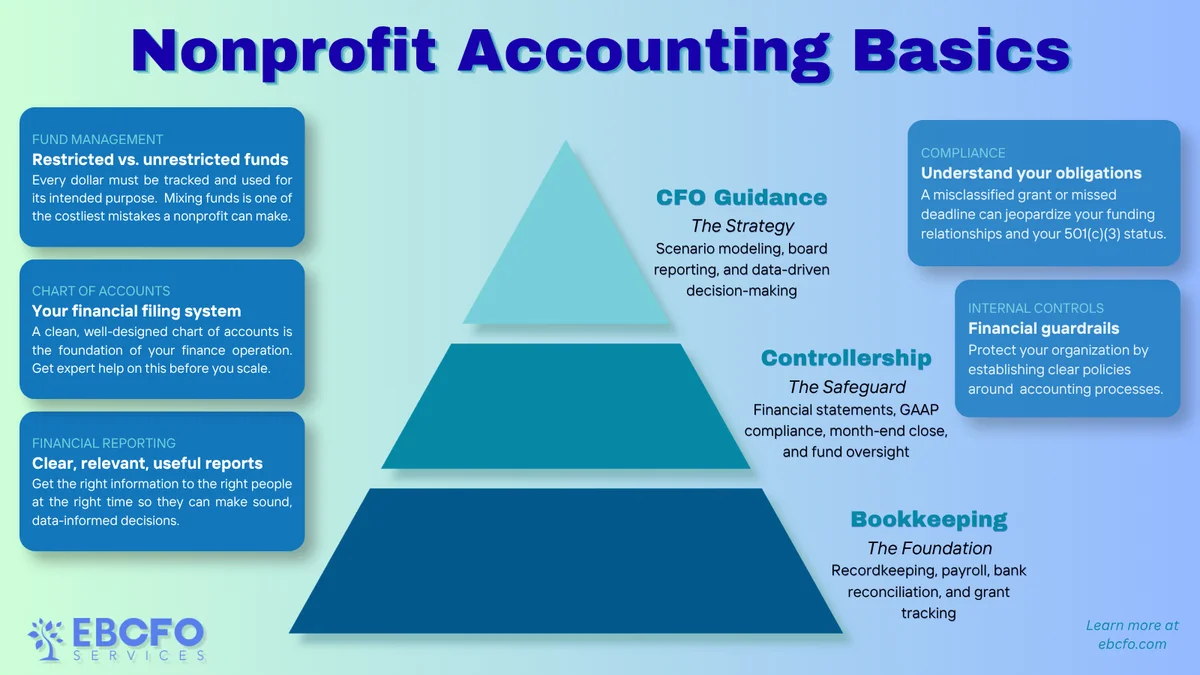
To make all of this work, there are three core functions that every nonprofit accounting operation needs to get right: bookkeeping, controllership, and CFO support.
Pillars of nonprofit accounting: bookkeeping, controllership, and CFO support
A healthy nonprofit accounting operation runs on three distinct functions, each operating at a different level of your organization:
Bookkeeping keeps your day-to-day financial records accurate and up to date.
Controllership ensures those records are compliant, well-controlled, and properly reported.
CFO-level support translates all of that into strategic insight that drives leadership decisions.
While fledgling nonprofits can get away with a fairly bare-bones accounting operation for a short time, it’s important to understand that these are distinct functions that can't be indefinitely combined without real risk to the organization. Each role requires its own skill set, and that separation creates a natural checks-and-balances structure that safeguards against errors, oversights, and misuse of funds.
Bookkeeping
Bookkeeping is, of course, the foundation of your accounting operation.
In this day and age, most of your day-to-day transaction data is probably logged automatically, so your accountant will likely spend most of their time processing vendor payments, managing payroll, and reconciling bank accounts.
Tracking donations and grant receipts is another core bookkeeping function, and it’s absolutely imperative that your bookkeeper understands the restrictions attached to each — a misclassified grant can create serious compliance headaches down the line.
Controllership
Controllership sits one level up from bookkeeping and is focused on accuracy, compliance, and financial controls.
Your controller is responsible for producing financial statements, managing the month-end close process, ensuring GAAP compliance, and keeping you audit-ready.
They're also the person who makes sure restricted funds are being tracked and spent correctly. With oversight being your controller’s primary function, it's important that this isn't the same person doing your bookkeeping — you need an independent set of eyes here.
CFO support
Your CFO is the strategy arm of your accounting operation.
They turn your data into actionable insight: assessing your current financial position, modeling out different financial scenarios, and helping your board and team develop a realistic path forward.
For young organizations, this role often falls to the Executive Director or a board member, and that's okay. But as you grow, you should consider either bringing on a fractional CFO or hiring one full-time. The demands of the role quickly outpace what a non-specialist can reasonably take on.
Key financial statements every nonprofit leader should understand
Unless you have a background in finance, it can be hard to know which accounting data you should be looking at.
The good news is that nonprofit financial reporting is fairly standardized, meaning there's a core set of statements every leader can familiarize themselves with. And once you do, you'll have a much clearer window into your organization's financial health.
Here’s a breakdown of the statements that matter most:
Statement | What it shows | Why it matters |
Statement of financial position | This is your balance sheet. It shows your organization's assets, liabilities, and net assets at a given point in time. | Tells you what you own, what you owe, and what's left. This document will help you decide whether you have the stability to take on new programs, hire staff, or weather a funding gap. |
Statement of activities | This is the equivalent of an income statement. It shows revenue and expenses over a period of time, broken down by net asset category. | Shows whether your organization is operating sustainably, or whether you might need to make cuts, diversify, or invest more in some area. |
Statement of cash flows | How cash is moving in and out of the organization across operating, investing, and financing activities | Keeping an eye on cash flow helps ensure you have enough liquidity to meet your obligations. Even if your Statement of Activities looks healthy, your cash flow statement might tell a different story. |
Statement of functional expenses | Expenses broken down by both their nature (salaries, rent, etc.) and function (program, management, fundraising) | This document helps you make the case to donors and grantmakers that your resources are being used responsibly. |
Restricted vs. unrestricted funds: What nonprofit leaders need to know
As a nonprofit leader, you already understand the basics of restricted and unrestricted funds: restricted funds come with strings attached, while unrestricted funds can be deployed wherever you need them. Simple though it may seem, there’s no shortage of ways this distinction can trip up even highly experienced nonprofit leaders.
From an accounting standpoint, keeping these funds totally separate is your number one priority. That means assigning the right designations in your accounting system from day one, maintaining detailed records of donor agreements and grant terms, and never, ever pulling from a restricted fund to cover a shortfall elsewhere, no matter how temporary it seems.
Setting your system up for proper fund tracking should put you in a good position when it comes to reporting — if you can see exactly how much you have available for your programs and operations, you’ll be well-equipped to make effective decisions re: resource allocation and fundraising.
What does a healthy restricted-to-unrestricted ratio look like?
Here, it’s worth taking a moment to dig a little deeper on restricted and unrestricted funds. As nonprofit CFOs, we’re constantly fielding questions about what a healthy balance should look like, and there’s no easy answer: depending on how capital-intensive your programs are and how your grants are written, restricted funds might cover a substantial portion of your operating costs.
But it’s not at all uncommon for nonprofits that bring in major grant funding to find themselves cash-poor in practice. You got a $1 million grant to fund your new initiative, but now you’re on the hook for an extra $250,000 to cover the associated overhead. Unless you have ample unrestricted funding or earned-income streams, you might be in a pickle.
Ideally, you’ve got a well-diversified funding mix that includes plenty of money to cover operations. To that end, you’ll want to think about how you communicate with funders: don't be afraid to negotiate grant terms, advocate for indirect cost recovery, and educate donors on why unrestricted giving is often the most impactful way they can support you. It’s also worth exploring social enterprise — if you can build out your earned-income streams, you'll have a reliable source of unrestricted revenue that isn't dependent on donor goodwill or grantmaker priorities.
The role of a chart of accounts in nonprofit financial management
Your chart of accounts is the master list of every category your organization uses to classify financial transactions — assets, liabilities, revenue, expenses, and net assets. Think of it as the filing system that makes sense of everything else.
For nonprofits, structuring your CoA correctly is especially important because you’ve got to track activity across multiple programs, grants, and departments. Get it wrong, and you open yourself up to the kind of reporting blind spots and compliance issues that can snowball into major headaches.
A well-designed chart of accounts, however, can be a major asset to your leadership team. You’ll have clear, accurate, usable financial data at your fingertips. It's one of those foundational decisions that's worth getting expert help on early, because retrofitting a poorly designed chart of accounts later is a painful process.
Budgeting for nonprofits: Planning for sustainability
Your budget is the bedrock of your organization’s strategy, and for nonprofits with big ambitions and finite resources, it’s imperative that every dollar is spent with sustainable growth in mind. As you construct your budget, keep the following in mind.
Operating budgets vs. program budgets
Your ops budget covers the full cost of running your organization — staff, overhead, administrative expenses, and everything else it takes to keep the lights on. Program budgets zoom in on the cost of delivering a specific initiative or service.
Both are necessary, and they need to talk to each other: a program budget that doesn't account for its share of organizational overhead is giving you an incomplete picture of what that program actually costs to run. When you set up your chart of accounts, make sure it's structured in a way that makes it easy to allocate shared costs across programs so you can price your grants correctly, advocate for adequate overhead coverage, and make informed decisions about program expansion.
Revenue forecasting for grants, donations, and earned income
Nonprofit revenue is rarely predictable, which makes forecasting more difficult and all the more important. For early-stage organizations, the temptation is to build an optimistic picture, but a realistic forecast will serve you far better. Here's how to approach it:
Start by listing every revenue source. Grants, individual donations, earned income, events, corporate sponsorships — whatever applies to your organization. Don't lump them together; each one behaves differently and needs to be forecasted separately.
Factor in timing. A grant award and a grant disbursement can be months apart, and your budget needs to reflect when cash actually arrives, not when it's promised. The same goes for donation campaigns and event revenue — map it to the month you expect it to land.
Build in a cushion. For any revenue source that isn't contractually guaranteed, apply a conservative estimate. A common approach is to forecast grants you're confident in at 80-90% of their expected value, and more speculative sources even lower.
Choose the right tools. Most fledgling nonprofits start with a spreadsheet, which is perfectly adequate early on. As you grow, dedicated nonprofit accounting software like QuickBooks Nonprofit, Sage Intacct, or Aplos can automate a lot of the heavy lifting and give you more sophisticated forecasting capabilities.
Monitoring budget vs. actual performance
Comparing your budget against actual performance should be a monthly habit. Most accounting software will generate a budget-vs.-actual report automatically. Pull it every month and look for variances above 10-15% on either the revenue or expense side.
When you spot a variance, don’t panic: while it's sometimes just a timing issue, it can also signal that a funding source is underperforming, that costs are creeping up in ways nobody noticed, or that your original assumptions were a little too rosy. Whichever it is, you’ll be able to address the problem in a timely manner so long as you’re keeping an eye on this report.
Internal controls and financial oversight
Internal controls are the policies and procedures that govern how money moves through your organization — who can approve an expense, who signs the checks, who reconciles the bank accounts, and who reviews that reconciliation. They might sound like administrative details, but they're the guardrails that keep your finances on track. Without them, you're exposed not just to fraud, but to honest mistakes that can be just as damaging if they go undetected long enough.
The good news is that you don't need a Fortune 500 compliance department to have solid internal controls. For most nonprofits, a handful of straightforward practices go a long way:
Require two signatures on checks above a certain threshold
Make sure the person recording transactions isn't the same person approving them
Conduct regular bank reconciliations and have someone independent review them
Restrict access to your accounting software on a need-to-know basis
Review your controls formally at least once a year — your organization changes, and your controls need to keep up
One common pushback is that internal controls slow things down, and poorly designed ones can. The goal isn't bureaucracy for its own sake, but a system where the right checks are in place without grinding operations to a halt. For smaller nonprofits, that means focusing your controls where the real risks are, rather than applying the same level of scrutiny to a $12 supply run as you would a $12,000 vendor contract.
Financial reporting for boards and leadership teams
Financial reports are only valuable if the people reading them can understand and act on them. Board members aren't always financial experts, and part of your job as a nonprofit leader is making sure the right people are seeing the right data — presented in a way that drives informed decisions rather than glazed eyes.
At a minimum, your board should be seeing your Statement of Financial Position, Statement of Activities, and budget-vs.-actual report at every meeting. Beyond the numbers themselves, context matters: a figure in isolation rarely tells the whole story, and a good financial report includes the narrative to go with it.
There's a lot more to say on this topic, which we cover in detail in The Complete Guide to Nonprofit Financial Reporting for Leaders and Boards.
Common nonprofit accounting mistakes (and how to avoid them)
Even well-run nonprofits fall into accounting traps; not usually from negligence, but from moving too fast with limited resources. Here are the most common mistakes we see, and how to sidestep them:
Overcomplicated financial systems. Many early-stage nonprofits rely on spreadsheets or off-the-shelf software that wasn't built with nonprofit accounting in mind, and outgrow them faster than they realize. Others invest in the right tools but don't set them up correctly from the start. Either way, the result is data that's hard to trust and reports that don't answer the right questions. Getting the right system in place early and configured correctly is one of the best investments you can make.
Poor grant tracking. Grants come with strict deadlines, restrictions, and reporting requirements, and losing track of any of them can jeopardize your funding relationship. Every grant should have its own designated tracking in your accounting system from day one, with clear visibility into what's been spent, what remains, and when reports are due.
Commingling restricted and unrestricted funds. Mixing restricted and unrestricted dollars, whether through sloppy bookkeeping or a poorly structured chart of accounts, is one of the most damaging mistakes a nonprofit can make. It puts you in violation of donor agreements, creates headaches at audit time, and can seriously undermine funder trust. Your accounting system should make it immediately clear how much of your cash on hand is actually available for general use.
Lack of process documentation. Many nonprofits operate on informal norms that work fine until they don't — a key staff member leaves, a new board member asks hard questions, or an auditor wants to see how decisions are made. Clear documentation covering expense approvals, reimbursements, fund management, and internal controls creates the standardization and continuity your organization needs to keep things running smoothly.
Letting financial reports collect dust. Financial reports that only get looked at once a year aren't doing their job. By the time a problem shows up at a quarterly or annual review, it’s had time to snowball. Monthly reporting for both leadership and your board isn't a nice-to-have; it's a core part of responsible financial management. The earlier you spot a problem, the more options you have. Make it a standing agenda item and treat it as non-negotiable.
When to seek outside accounting support
There's a point in every growing nonprofit's life when the accounting function that got you here stops being sufficient for where you're going. Recognizing that inflection point early can save you a lot of pain. Here are some signs it might be time to outsource:
Your bookkeeper is fielding questions they're not equipped to answer
Financial reports are taking longer to produce and contain more errors
Grant reporting feels like a scramble
Your board is asking for financial analysis that nobody has time to produce
You're growing your program portfolio but have no clear picture of what each program actually costs to run
If your organization is showing any of these signs, it may be time to bring in outside support. At EBCFO, we provide end-to-end financial management for nonprofits, covering everything from day-to-day bookkeeping and controllership to fractional CFO services and strategic financial consulting.
We work exclusively with 501(c)(3) organizations, which means we understand the funding structures, compliance requirements, and reporting demands you're navigating. If you're ready to move beyond spreadsheets and get the financial clarity your mission deserves, we'd love to talk.
Takeaway: Good accounting is mission-critical
The most successful nonprofits aren’t those that bring in the most funding; rather, it’s the ones that have the financial infrastructure to scale their work over time that end up making the most impact. Sound accounting practices give you the data you need to make confident decisions, the credibility to attract and retain funders, and the resilience to weather the inevitable bumps along the way. Whichever growth stage you’re in, the time you invest in getting your finances right will pay off in spades.